Search This Blog

Showing posts with label Explanations. Show all posts

Sunday, January 11, 2015

Why #100PicsOfBeauty


To kick off this blog post, here are the top 3 most liked of my #100PicsOfBeauty on Instagram:

#1 (two-way tie)

A photo posted by JR (@r4nd311) on
My housemates and I hosted a small Memorial Day gathering at our house, and we hung an American flag like this while we were grillin' and chips and salsa-ing.

#1 (two-way tie)
A photo posted by JR (@r4nd311) on
One of my housemates purchased this statue of the Immaculate Heart of Mary, and she watches over our front yard. I'm referencing Genesis 3: 15 in the caption.

#2

A photo posted by JR (@r4nd311) on
My Knights of Columbus council has a hall, and in front of the hall is this statue. I was stopping by at my youth group's softball practice when I noticed a dramatic looking sunset from the other side of the hall. Someone suggested to me that  I should go to the other side of the hall and take the picture, but then I noticed (for the first time?) that this statue exists. Couldn't resist.

#3 (three-way tie)

A photo posted by JR (@r4nd311) on
We had some crazy weather back in December 2013 where it was still relatively warm, but got immediately cold and icy. Early on, we had freezing rain after some warm weather so that's why the roses are still vibrant but now iced over. 

#3 (three-way tie)

A photo posted by JR (@r4nd311) on
My parents and I visited family up in Canada last summer by meeting up with them in Vancouver. I got to see various sights around Vancouver, including a famous suspension bridge at Capilano Suspension Bridge Park north of Vancouver. This is a view from the bridge.

#3 (three-way tie)

One of the benefits of driving so freakin' far away for work was finding out about a really beautiful German-style painted Catholic church in north Texas. I wanted to pray here before lunch so I went in, but heard a buddy of mine practicing sacred music upstairs at the organ in the choir loft. So I went up there, and noticed how cool the organ looks.


And why would I do such a thing, taking 100 pictures on Instagram regarding beauty?

Back in 2013, I had this crazy idea of registering for a young adult conference that was to happen right after I returned from my trip to Rio de Janeiro for World Youth Day. Like, arrive home Wednesday, go to work Thursday and Friday, and starting on Friday night attend this conference for the rest of the weekend. No rest for the weary.

The keynote speaker for the conference was Gene Monterastelli. He’s a Catholic speaker, storyteller, and writer. Most of the content of his keynotes were about how he navigates through life in practical Catholic ways. In particular, he talked about the 2012 presidential elections and how he noticed social media (Twitter specifically) had become a toxic forum regarding those elections. He was really bothered by that, so he decided he would inject some sort of antidote to combat the toxicity of discussion online.

His answer was #100tweetsofbeauty.  Simply just a tweet highlighting a beautiful moment or experience, online or in the real world. You can check out his #100tweetsofbeauty here.

After the conference and listening to him speak, I was inspired myself to do something similar. The late summer of 2013 didn’t have any particular dramatic controversies, scandals, or The Next Worst Thing Ever™.  At least, not that I can remember. Rather, I wanted to start something similar in order to combat the toxic ways I, myself, view the world sometimes.

So that’s when I decided to do #100picsofbeauty on Instagram (and shared via Twitter and Facebook). I like taking pictures, and I used no filters when capturing these moments. Anything that gave me pause and at least a brief sense of awe, wonder, and transcendence, I captured on my Instagram. Because that’s what beauty can do: bring about a sense of awe and wonder in a transcendent way.

It took me from August 2013 to November 2014 to complete it. Most times, a beautiful moment presented itself to me making it easy to capture that moment on Instagram. But there were a few times where I really had to stretch and seek beautiful things out. I realized just now as I'm writing this that beauty is all around us, but only if we are open to it and are looking for it are we able to acknowledge it. And respond to it.

As I was doing the preparation for this blog post (like making a spreadsheet of Like counts from Instagram per picture (omg, I accidentally did #47 twice (#101picsofbeauty))), I began to remember those moments and how awesome they were at the time.

I would say my personal mission to combat the toxic ways I view the world is a success. Doing #100picsofbeauty allowed me to pause and really reflect and contemplate on the beautiful moments of life, even in the littlest and trivial-est of things, that I would have otherwise bypassed without much thought.

We live in such a culture today that teaches people to seek pleasurable things, indulge in it briefly, and move on. But the problem with that is that it doesn’t teach me to really be consumed by authentic beauty that transcends (ie. that lasts more than a brief moment). My life is not a series of sensations, but a work to be accomplished and getting lost within the beauty of this world. That sense of infinite resonates within my being and helps me understand that there’s more to this life than simply what I observe and experience. After doing this at least 100 times, now I’ve formed a better habit to seek beauty.

So, I’ll return to my normal scheduled Instagramming, but I challenge you, dear reader, to take moments to pause and acknowledge the beauty happening in your life. Feel free to use the hashtag #100picsofbeauty (if you take pictures) as I’m the only one on Twitter who has used it so far.

“Beauty will save the world.” -Dostoyevsky, The Idiot
- JD

Sunday, June 23, 2013

Why I Am Going to Rio De Janeiro


I've been hinting at a trip to Rio since like...a year ago, albeit largely infrequently.  But I never really explained why.

Back in the mid 1980's, Blessed Pope John Paul II invited young Catholics to Rome for a jubilee celebration on Palm Sunday in St. Peter's Square.  Over 300,000 showed up, and he was impressed.  The following year, coinciding with the United Nation's International Year of the Youth, he invited youth to come to Rome again. After that one, Pope John Paul II instituted World Youth Day as like...a normal thing.  Since then, World Youth Days are held every few years internationally.
WYD 2011 in Madrid, Spain. (DICI)
WYD 2008 in Sydney, Australia. (Fr. Chris Ryan, Wordpress)
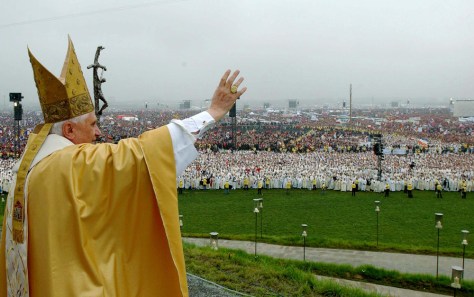
WYD 2005 in Cologne, Germany. (NBC News)
Back in high school, even though others from my parish made plans and effort to go, I never thought of actually going from a practical standpoint, but I always thought it would be cool. Simply put, time and money were things I didn't really have back then. In college, same thing. But, I was able to vicariously experience World Youth Days in Madrid, Sydney, Cologne, and Toronto through the pictures and stories of friends who went. Maybe someday, I thought.

Two years ago in 2011, I had some friends who ended up going to World Youth Day in Madrid, España. An opportunity came up in my diocese where one of the parishes invited us and a few other parishes to come watch a concert and have a lock-in to watch the closing Mass of World Youth Day Madrid streamed live.  Being the budding and aspiring pro chaperone at the time, I decided to tag along thinking it would be cool to see with my own eyes what a Mass gathering for World Youth Day looks like. Via streaming. ;-)

Can you find my friends? >_> White = altar, dots = people
Since Madrid is several hours ahead of my time, the Mass started at some awkward part in the early morning for us.  And it was a lonnnnnnnng Mass simply because millions were gathered. At an airport tarmac. O_o

Fast forwarding to the end...it came time for Pope Benedict XVI to announce the when and where of the next World Youth Day.  I remember being like...super tired because it was like...4AM or so, and I had been up all night and watching the Mass.  But the anticipation of hearing the announcement for the next World Youth Day was enough to wake me.


So Pope Benedict XVI announced that the next World Youth Day would be in 2013 in Rio De Janeiro, Brazil.  I remember thinking how cool that would be and somewhat wishful thinking as well because I had the desire to go, but I wasn't sure of the means of how I'll go.

I guess I kept that wishful thinking in the back of my mind for about a year because I didn't actively pursue any avenues to make a trip to Rio happen. In the summer of 2012, I learned that a group was being organized by the folks over at The Shepherd's Café. Their ministry leader invited me, actually. Really, this was the only local organized group planning to go that I had heard about at the time, and it was mighty tempting for me to be part of their group. Their trip seemed pretty interesting because it involves a mission trip aspect to other southern American countries before going to Brazil.  I really wanted to go to World Youth Day, and I nearly made an executive decision to go with them. My concern was cost because their trip would be more expensive due to their travels to other countries. But I figured that...I'll pay up because it's a very unique opportunity, and I really wanted to World Youth Day.

I told some people at my parish that I was thinking about going with this group and kind of left it at that as I waited for the next informational.
...And I never ended up going to that informational.

Because, unbeknownst to me, there were some plans being made to send some youth from my parish to World Youth Day in Río! Annnnnddddd! We would be combining with another parish in the diocese!

Since I had expressed my desire to go, I was asked if I would chaperone. No hesitation in saying "yes!" and I made the executive decision to go!

Without spoiling details...this combined trip wouldn't be the same as the other one that I was thinking about joining. Our trip would be more pilgrimage-style experiencing the full week of events at World Youth Day with some free time spent in Río visiting iconic places and churches.

So we had initial meetings last summer to discuss basic info, the documentation required, cost, and all that jazz. That's when I made (and blogged about) an executive decision to join my (combined) parish group.  I'm pretty stoked!

I just recently found out that the hostel that my group is staying at...is sharing the hostel with only one other group: the Shepherd's Cafe group! Totally unintentional on our parts! Haha.

And fun fact! The other parish that I'm combining with is the same parish that we went with to the March For Life in Washington, D.C. back in January! Really, this pilgrimage was a sort of warm up to our trip to Rio!

Now, on a surface level, World Youth Day seems like a time for young Catholics to come together from all over the world to see the pope. As initially cool as that seems, that is not my primary reason to go. Yeah, maybe in high school and college that would have been my reason, but knowing what I know now and where I'm at in my faith, that seems a little too surface-level for me.

I think what draws me to go is to experience the Church in its universal glory united in Jesus Christ. In addition, to learn more about the faith and to have an authentic encounter with Him with (millions gathered of) like-minded young people. Most of the time it is too easy to confine my experience of the Church to the grounds of my own parish and chunk of land that is my diocese. But, truly, at the end of the Gospel of Matthew, after Jesus rose from the dead and revealed His glorified self to His apostles, He commissioned them to "make disciples of all nations...teaching them all [He had] taught them." Was this even remotely accomplished or has progress even been made? I think the answer is a resounding yes. And going to World Youth Day, I'll be able to experience the universal Church through the joyful and cultural expressions of those millions gathered for this event from all. over. the. world. And I think that's really cool!

Psh, the Catholic Church is not merely our buildings or simply an institution. The Church is a living organism, and it will be awesome to see the Body of Christ in a way that I've never seen before in person.  The hundreds of thousands gathered for the March for Life in Washington, D.C. earlier this year pale in comparison to the millions of people who gather for World Youth Day.

But don't get me wrong!!! The secondary motivations of going are still pretty exciting!  I mean, come on!
  1. RIO DE JANEIRO! I've never been south of Cancun, Mexico, much less anything Southern American, and to visit Rio would definitely be an awesome experience to see with my own eyes.  Experiencing the culture, seeing the Sugar Loaf Mountains, the Christ the Redeemer Statue, and Copacabana Beach! And other places!
  2. COPACABANA BEACH! This is where Pope Francis will welcome us all at the beginning!
  3. THOSE GUYS! One of my favorite priests and one of my favorite Franciscan Friars of the Renewal are going with us! Basically, we can have Mass and Confession anytime! And the friar is really good at singing and guitar-playing!
  4. MEETING NEW PEOPLE! We're going to interact with a lot of people from all over the world.  A thing to do is to exchange swag, so I'm stocking up on some small Texas things!
  5. POPE FRANCIS! Yes, seeing the Pope would be really cool! World Youth Day 2013 is his only scheduled trip outside of Italy this year!
  6. TO LEARN! Heaven forbid that Catholics don't learn how to be Catholic! Part of WYD is they provide catechetical sessions so that everyone can learn something more about their faith!
  7. TO GROW DEEPER IN MY PRAYER LIFE! Knowing the group I'll be going with, there will be lots of Liturgy of the Hours, Mass everyday if possible, Divine Mercy chaplets, chants in Latin, and other things.  We're also all doing the preparation for the Total Consecration to Mary!  Just in my own preparation, I'm learning more about myself.
  8. TO FLY! As an aerospace engineer...I love any opportunities to fly on airplanes!  To make it extra nerdy for me...I'm also curious about the airline seats since airline seating is my job!
  9. AND MORE! Many more to list, I'm sure!
I'm grateful for the engineering career that I have for it has enabled me to have the vacation time and monetary means to make this trip possible for me to go on. Seeing how all this has that "everything just worked out" vibe with relative ease...I think that I was definitely not meant to go to the previous World Youth Days.  I'm meant to go to this one, for whatever ultimate reason.

We'll find out.
Vamos para o Rio de Janeiro!
- JD

Christ the Redeemer Statue / LoveThesePics.com
Aerial View of WYD Madrid / PontoEletronicDD @ Flickr

Thursday, June 13, 2013

Total Consecration

Some blog posts ago, I reflected on who the First Christian seems to be.  I would say that this first Christian is none other than the human being who knew Jesus first and most intimately--His mom.

As Catholics, we do not worship Mary but definitely hold her in high regard, just as God Himself holds her in high regard. Just as getting to know Jesus helps us better understand God the Father, getting to know Mary better helps us understand Jesus.

I think as Christians, we really miss out on a lot if we disregard Mary and her role in bringing Jesus, quite literally, to us. 

Exploring that role shows how devoted Mary was to her son.  Getting to know some her shows that she wants nothing more than for us to get to know her son more.  And she will help us...intercede for us...bring us closer to Him.

So, as Christians, we are devoted to Christ--as we should be!  From a Catholic perspective, we give Mary honor because she is the greatest creation by God, and she brings us to Christ.  Therefore, it is not surprising that Catholics can have a devotion to Mary with the ultimate purpose of being devoted to Jesus.  To Jesus through Mary.

Pope Paul VI once said:
We are convinced without any doubt that devotion to Our Lady is essentially joined with devotion to Christ, that it assures a firmness of conviction to faith in Him and in His Church, a vital adherence to Him and to His Church which, without devotion to Mary, would be impoverished and compromised.
And in the Vatican II apostolic constitution, Lumen Gentium (60, 67), it says:
The maternal duty of Mary toward men in no way obscures or diminishes this unique meditation  of Christ, but rather shows its powers.  All her saving influence on men originates not from some inner necessity, but from the divine pleasure.  It flows forth from the superabundance of the merits of Christ, rests on His meditation, depends entirely on it and draws all its power from it.
...the practices and exercises of devotion to her recommended by the Church in the course of the centuries [are to] be treasured...
Devotion to Mary, then, ultimately bears fruit in knowing Jesus that much more.  And as a Christian, why wouldn't I desire that?

Most people are familiar with the Rosary since it is probably the most recognizable tool in having a devotion to Mary.  But most people are probably not aware of its purpose and use in devotion.  Long story short, praying the Rosary is asking Mary for her help in meditating through the life of Christ by reflecting on the major milestones of His life recorded in the Gospels.  It's like...prayerfully going through the Gospel without necessarily using a Bible.

Yes, Rosary is a big one.  But then there's St. Louis Du Montfort.  He was a French priest who lived in the late 1600's.  He went around spreading devotion to the Virgin Mary throughout Europe.  This guy absolutely loved Mary and developed spiritual exercises in order to consecrate oneself to Mary as a form of devotion.

But his True Devotion to Mary is an intense exercise in spiritual life involving much reflection, emptying oneself of the worldly spirit in order make room to gain knowledge of self, then knowledge of Mary, and thus ultimately knowledge of Christ.  He prescribes 33 days at which to devote daily prayer and meditation to consecrate oneself to Mary.  You begin by choosing a Marian feast day then counting back 33 days to start the consecration.

Why do I even care about this?  Well, I think over the past few years, I've really developed my Catholic knowledge through religious education, teaching that, and learning apologetics.  I've always felt lacking in spiritual development, and this is a great opportunity.  That's why it was quite refreshing when I went to on a silent retreat a few months ago.

And then I'm mostly motivated to do this consecration since my pilgrimage group for next month's trip to Rio De Janeiro will all be doing this as well.  Actually, I'm starting a little earlier with a friend or two than the rest of my pilgrimage group so that whenever I finish up, it will actually be a feast day (Our Lady of Mt. Carmel) since there are no Marian feast days during our pilgrimage.

I'm excited and at the same time nervous...simply because I tend to lack discipline in maintaining a new habit. And then things are crazy right now with work, pilgrimage prep, and everything else I've got going on at my parish.

But, I think the fruits of going through this devotion will be much needed.

Challenge accepted.

Ad Jesum per Mariam,
- JD

Saturday, April 20, 2013

Divine Mercy


Click here to scroll down to instructions on how to pray the Divine Mercy Chaplet.

Before explaining what Divine Mercy is, I should define what is "private revelation." If you already have an understanding, then don't click the following link.

What is private revelation...?


With all that said (if you read it), that leads me to Divine Mercy.  Essentially, Jesus gave us a clearer understanding of His infinite and divine mercy through private revelations given to a Polish religious sister named St. Maria Faustina Kowalska.

Who is St. Maria Faustina Kowalska?

Her original name is Helena, and she was born into a poor, peasant family in Glogowiec, Poland.  She was the third oldest of ten children, and "from childhood she distinguished herself by her piety, love of prayer, industriousness and obedience as well as by her great sensitivity to human misery" (Diary, xv).  At the age of seven, she started feeling the call to religious life.  Her parents were not keen on letting her join a convent, and she tried repressing her desire to join a convent.  But from a vision of the suffering Jesus, she strengthened her resolve to join a convent.  She ended up in the Congregation of Sisters of Our Lady of Mercy in Warsaw.  There, she received the name Sister Maria Faustina.  She completed her novitiate (basically, the novitiate is the newb stage to religious life) and professed her perpetual vows of poverty, chastity, and obedience after five years of being in the convent.  She worked in various houses for the Congregation in different locations in Poland, especially as cook, gardener, and doorkeeper.

Sr. M. Elizbaeth Siepak writes in the Introduction of St. Faustina's diary:
To all external appearances nothing betrayed her extraordinarily rich mystical life. She zealously went about her duties, she faithfully observed all the religious rules, she was recollected and kept silent, all the while being natural, cheerful, full of kindness and of unselfish love of neighbor.  
Her entire life was concentrated on constant striving for even fuller union with God and on self-sacrificing cooperation with Jesus in the work of saving souls. (Diary, xvi) 
The Lord also endowed her with many graces and gifts.  These include the gift of contemplation with deep knowledge of the mystery of God's mercy, visions, revelations, the hidden stigmata, the gift of prophecy and reading into human souls, and also the rare gift of mystical espousals.  However, she wrote:
Neither graces, nor revelations, nor raptures, nor gifts granted to a soul make it perfect, but rather the intimate union of the soul with God.  ...My sanctity and perfection is based upon the close union of my will with the will of God (Diary, par. 1107)
I'm a fan of that last sentence.  She willed to align her will to that of God's will.

As she grew older, she started having health problems.  And sometimes she experienced a profound spiritual suffering known as the "dark night" where a soul doesn't receive any consolation from God as if He has abandoned the soul.  She grew very sick and eventually died in 1938 at the age of 33.

Because of the life she led, her personal piety and obedience to God's will, and passionately serving as a conduit to God's message of mercy, she was canonized as a saint by Blessed Pope John Paul II in April 2000.

How was Divine Mercy revealed?

She kept a diary, which is out in publication.  Apparently Jesus revealed to her that she should keep one.  I started reading it a while ago, but haven't yet finished it.  In it, she shares her daily struggles with religious life and life in general, but most intriguingly she wrote down what Jesus said to her whenever He appeared. It's almost conversational, as if St. Faustina was really talking to and listening to someone.  Or rather...Someone.

Through these private revelations, it is clear that Jesus was with her throughout her life, especially during her times of suffering.  Though He spoke to her a lot, I want to focus on His message of Divine Mercy.

Again, from the Intro, Sr. M. Elizabeth Siepak summarizes Jesus' mission for St. Faustina:
"Today, I am sending you with My mercy to the people of the whole world. I do not want to punish aching mankind, but I desire to heal it, pressing it to My merciful Heart" (Diary, par. 1588)
"You are the secretary of My mercy; I have chosen you for that office in this and the next life" (Diary, par. 1605) ... "to make known to souls the great mercy that I have for them, and to exhort them to trust in the bottomless depth of My mercy" (Diary, par. 1567) 
Her mission is to remind us about the truths of God's merciful love for us as well as providing us with new ways to have a devotion to The Divine Mercy.  There are several ways to have a devotion to Divine Mercy as revealed to St. Faustina by Jesus. They are as follows:
  • The Divine Mercy Image (seen at the top of this post), which is a painting of a vision St. Faustina had of Jesus.  The elements of the image has special meanings.
  • The Feast of Divine Mercy, which is the day that Jesus specified to focus on the shelter of His Mercy. He specifically said that the second Sunday of the Easter season (ie. the Sunday after Easter) is to be the Feast of Divine Mercy.  Blessed Pope John Paul II declared in his homily at the canonization of St. Faustina that the second Sunday of Easter will be known as "Divine Mercy Sunday"
  • The Chaplet of Divine Mercy, which is a prayer of atonement and appeasement of God's wrath dictated to St. Faustina by Jesus
  • The Novena to Divine Mercy, which is a 9-day recitation of the Chaplet in preparation for the Feast of Divine Mercy or for whatever petitions by the faithful
  • The Hour of Mercy, which Jesus specified as the third hour whereby the faithful should focus and immerse themselves in his Mercy
More info about each can be found in the intro of her diary by Sr. M Elizabeth Siepak or at DivineMercy.org.

Sunday, March 24, 2013

Palm Sunday

I was at a retreat this past weekend (future blog post), and the priest leading the retreat mentioned how one of his old students texted the link to the YouTube video below.

First, some background.  For most Christians, the Sunday before Easter is known as Palm Sunday or Passion Sunday.  On this day, we commemorate Jesus' triumphant arrival entering into Jerusalem (Matthew 21:1-11, Mark 11:1-11, Luke 19: 28-40, John 12:12-19).  This was a big deal because the people of Jerusalem had heard about the works of mercy and miracles Jesus performed in neighboring cities.  And they welcomed him by laying palm branches and their cloaks on the ground as he rode in on his donkey with his disciples following him.

For Catholics, Mass always begins with a procession.  And for Palm Sunday, usually the priest invites the congregation to meet outside of the church for a blessing of the palm branches.  Then he reads a Gospel account of Jesus entering into Jerusalem.  After this, the priest and his helpers (deacons, acolytes, altar servers) process in with the congregation carrying palm branches to signify this triumphant arrival of Jesus in Jerusalem.

And every Catholic Mass has a reading of the Gospel, and every Palm Sunday, an account of the Passion is read from Jesus' betrayal to his burial in the tomb because it prepares us for Holy Week and to reflect on the Passion before we celebrate His Resurrection on Easter Sunday.  I'm not sure how other parts of the Catholic world read it, but at least here in the United States, the Passion is read in parts.  Usually the priest reads what Jesus said, another speaker reads stuff like what Pilate, Herod, and other individuals said.  Another person narrates.  But the whole congregation participates too at certain points.

For example, you can read Luke 22: 14-23 and kind of see how you could split the dialogues into different parts.  Now, this is not a performance even though everyone has a speaking part.  It is an active participation of the Gospel, moreso than usual, for everyone.  Yes, in words, but with the intent of really placing ourselves in that setting of Jerusalem 2000 years ago.  Or at least, everyone needs to be fully engaged and actively participate.  But why? Why do it this way?  Do we get anything out of it by doing it this way?

With all that in mind, that provides the context for this video and perhaps it illustrates the answer to why it is done this way:


Crucify him! Crucify him!
- JD

:-/


Friday, March 8, 2013

How To Become Pope


Yeah, it's cool to think that I mostly qualify...though I do lack that whole cardinal thing, and I don't think throwing the first pitch at the next home game counts. #pun


But I mean...my dad went to high school with a recently named cardinal...maybe that's my in...

In all reality, I don't know any cardinals personally so ... don't worry--I'm not becoming the Pope.

;-)

*Updated
From Jimmy Akin, senior apologist at Catholic Answers: he points out some incorrect things in the video:

1) It wrongly implies that the pope can simply veto the name of a potential bishop that is presented to him, causing the process to start over.

In reality, the names of all three proposed bishops are presented to the pope, who may choose the recommended one, another one, select another person entirely, or call for the process to start over.

2) It wrongly refers to the "Congress of Bishops" in Rome. Actually, it's the Congregation for Bishops.

3) It wrongly states that have to pick your new name before becoming pope. Actually, this is the first thing a pope does after being elected and accepting his office.

Assuming he's already a bishop (the scenario that the video presupposes), he becomes pope that moment, before they ask him what name he wants to be called by.

4) The video wrongly states that “it’s usually at least two weeks of voting” at a conclave.


Not in recent history. In the 20th century (and 21st) no conclave has gone over 5 days. See this handy infographic:


from the Washington Post

#papabile
- JD